
When Summer Wind Peels a Beasley Roof Back at the Edges
A gust off a summer storm does not need to tear a roof open to ruin it. It only has to break the seal under a row of tabs. We find out whether that happened to a few shingles or a whole slope on your Beasley house, photograph it, and tell you plainly which one you have.
Veteran BuiltBeasley, Texas
Storm lines that cross Loop 540
Beasley is a town of 608 people, counted in 2020, strung along State Highway Loop 540 with the Union Pacific tracks running next to it and US 59 passing just south. The summer thunderstorms that push straight-line wind across Fort Bend County reach it like anywhere else, and the roofs that take the first hit are the ones facing the line as it rolls in.
The Gulf season, June through November, adds a second risk. A tropical system brushing the coast can send gusts inland for hours, and long, steady wind works on a roof differently than one hard burst does. It tests every seal strip in turn. After either kind of storm we start where uplift is worst, at the rake edges, the eaves and the ridge, and work inward from there.
Plenty of Beasley lots carry more than one roof: the house, plus a shop, a barn or a carport out back. Wind does not pick favorites, so we look at all of them on the same visit. Each building gets its own line in the written scope, with its own photos, and you choose whether the outbuilding gets fixed now or waits.
Every shingle is glued to the course below by a strip of sealant that the sun sets after install. Wind gets under the leading edge, pries, and if the bond breaks the tab flaps. Each flap bends the mat along the same line until it creases. It can settle back flat and look fine from the street, and it is still finished, because the fiberglass inside has been folded and will tear at the fold next time.
So the inspection is hands-on. We lift tabs gently along each slope to see whether they are still stuck down, look for the line a crease leaves across a tab, and check the rakes, where a gust can peel the edge shingles back and expose the starter. Sometimes a whole slope has been stripped down to felt. Sometimes it is a short row over the garage that can be sealed down by hand. The photos show you which, and we say it in plain words.
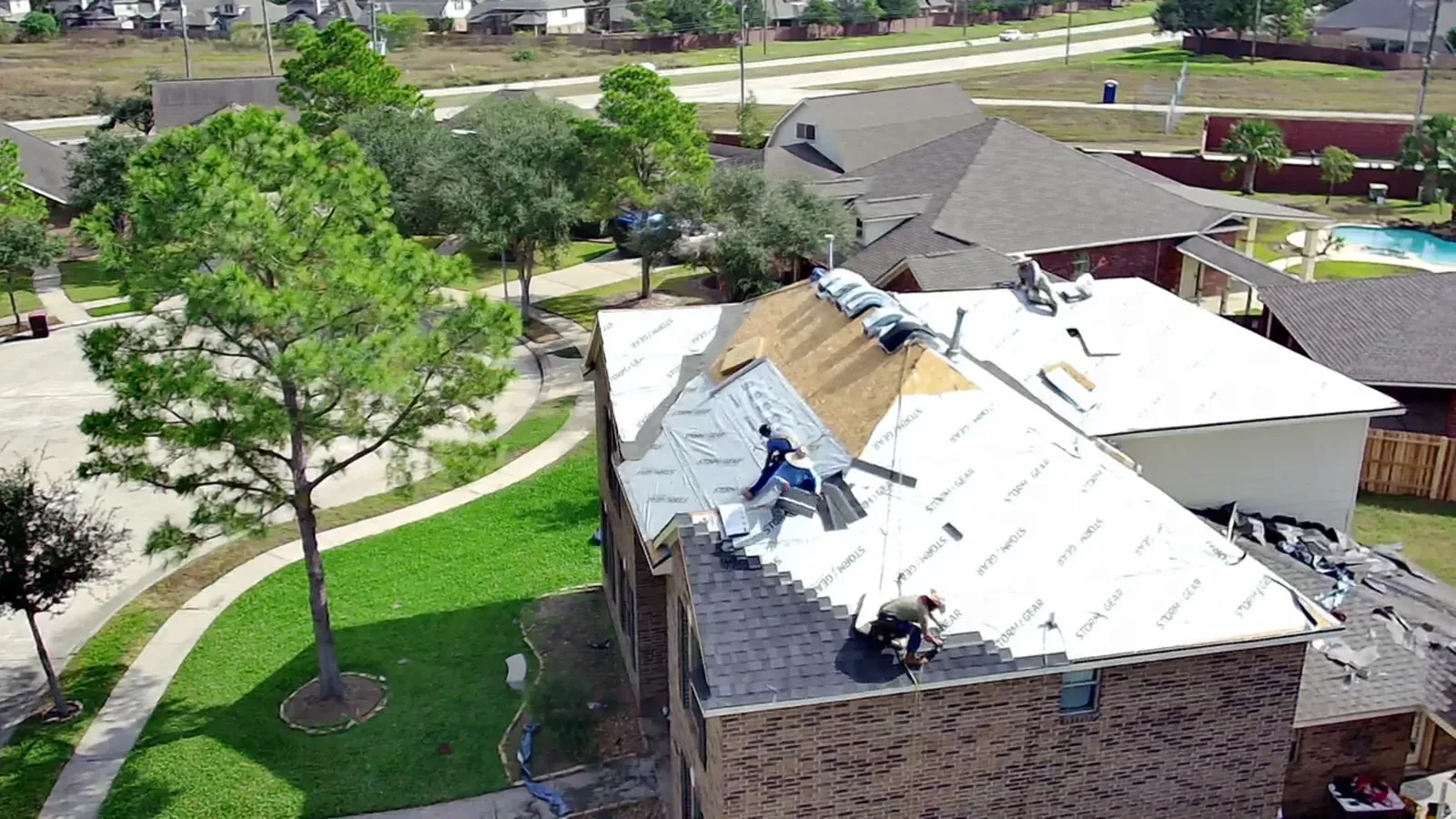
When the answer is a new roof, the edges get the most care, because that is where the next storm will start pulling. A starter strip lines every eave and rake, giving the first course something to seal against, the drip edge is fastened down tight, and the field shingles go on with the extra nails the maker asks for where wind runs high. Hip and ridge caps get the same attention.
A few loose tabs, or a roof that lost its grip
Wind leaves two very different kinds of roof behind, and the job you need depends on which one is on your house.
- Tabs lift with almost no pull on several slopes, which tells us the seal strips have let go across the roof and will keep failing storm after storm.
- A whole face of the roof was stripped down to felt or underlayment, and the shingles around the bare patch are creased in long rows.
- The rake edges peeled back along both gables, and the shingles left on the roof are too old and faded for new ones to blend in.
- Creases show up on most slopes after more than one summer storm, so patching this season’s losses would only set up next season’s repair bill.
- Six or eight tabs lifted over one corner, with the rest of the roof still stuck down, get sealed or swapped out, and that is the whole job.
- A ridge cap or two blown off a sound roof is a ladder and a bundle of matching caps, and we will tell you that before anything else.
- Wear from age that happens to sit next to a storm’s damage stays labeled as age in our photos and the written scope, and we keep the two apart.
- If a limb came through the decking, the first job is drying the house in, and the bigger roof question waits for a calm, dry day.
Edge to edge, then into the scope
- I
Walk the edges
One of the owners climbs up and starts at the rakes, eaves and ridge, since that is where wind pulls hardest. Tabs get lifted by hand along each slope to test the seal, and any carport or shop roof on the lot gets the same look before anyone climbs down.
- II
Photograph it all
Every slope is photographed wide and close before a single shingle comes off, creases and lifted edges marked so you can find them. You keep the full set. The decision to file, and what any policy pays, belongs to you and your carrier, and we stay out of it.
- III
Write the scope
The written scope says repair or replace in plain words, slope by slope. A shop or barn roof sits on its own line with its own photos. A house inside the limits needs a City of Beasley permit, and that goes into the schedule.
- IV
Rebuild for the next gust
Tear-off, a check of the decking, new drip edge and starter, then the field and caps nailed the way the maker calls for where wind runs high. Before the crew leaves, we photograph the finished edges so your file shows what went back on.
What we ask after a windstorm
- Which day did the storm come through, and which side of the house faced it?
- Have you found shingles or pieces of them in the yard or the street?
- Is there a shop, barn or carport on the lot we should look at too?
- Has any water shown up on a ceiling or around a window since?
- Have you already called your carrier, or are you still deciding?
Can a roof have wind damage if no shingles came off?
Yes, and that is the kind most people miss. A gust can break the seal and crease a row of tabs that then settle back down. From the ground the roof looks whole. Lifting tabs by hand is the only way we know to find it, so we test every slope.
Will you tell me if it only needs a repair?
If the seals are holding on most of the roof and the losses sit on one edge, the scope says repair. If the whole roof has lost its grip, it says replace. Leland puts it plainly: if the roof needs replacing, he says so, and if it does not, you hear that instead.
Will you deal with my insurance company?
We photograph every slope, write down what the wind did, and will walk the roof with an adjuster if you ask us to. Filing is your decision. What the policy covers and pays is settled by you and your carrier, and we make no promise about how a claim turns out.
Is summer straight-line wind as bad as a hurricane for a roof?
On a single house it can be. A thunderstorm line can push gusts hard enough to strip a slope, and it often hits one face of every roof on a street the same way. A hurricane lasts longer and tests more seals. Either one gets the same inspection from us.
My shop roof took damage too. Do you handle both?
We look at both on the same trip and write them as two separate lines, each with its own photos. Shingles on the house and metal panels on a shop are different jobs. Which one goes first, or whether the shop sits until later, is your call.
Will a new roof hold up better against the next storm?
It should, if the details are right. Most wind failures start at a weak edge or shingles nailed too high. We set the starter strip, drip edge and nailing to the maker’s high-wind instructions and check the seal on the caps. No roof is windproof, and we will not tell you otherwise.
Who climbs up after the wind
Geoff Schardien, one of the two owners, served in the Air Force Security Forces and has spent more than twenty years in residential construction. After a windstorm that experience is what counts on the roof: knowing a weathered crease from a fresh one, and knowing which lifted edge a hand sealer can save and which one is already gone.
You get one phone number for the whole job. The person who answers it on the day you call about lifted shingles is the same person you reach once the new roof is on and the dumpster is gone. Nobody passes your Beasley roof to a stranger halfway through, and the story you heard on the first visit does not change.