
After Hail Hits Arcola, the Photos Come Before the Pry Bar
Spring hail does not land evenly. One Arcola street can take a beating while the next one over gets a few scuffed vents. Before anyone talks about a new roof, we find out what the stones did to yours, photograph it slope by slope, and hand you the pictures to use however you decide.
Veteran BuiltArcola, Texas
Spring storms over a small, flat town
Hail season around Arcola runs through the spring, when big storms build over the coastal plain and drop ice along a narrow path. A town of about two thousand people on two square miles can have half its roofs hit and half spared in the same afternoon, so a neighbor’s claim proves nothing about your roof in either direction.
A bruised shingle does not leak on day one. The mat cracks under the strike, and the next heavy Gulf Coast downpours push water at that crack again and again, until it reaches the decking. On a low-pitched slope that can happen sooner than on a steep one. That is a big part of why we want the damage documented while it is fresh.
Wind usually rides along. Straight-line gusts run ahead of many spring and summer storms, so a hail inspection here also checks for lifted and creased tabs on the side that faced the weather. If the replacement goes ahead and the house is inside the city limits, the City of Arcola permits and inspects the new roof; outside the line, no city permit is involved.
A real hail strike leaves a mark you can feel. Press the spot and the mat underneath gives, the grit around it is gone in a rough ring, and sometimes a crack runs through the fiberglass. Cosmetic marks can look similar at a glance: shallow scuffs, a little missing grit, a dent in a metal vent. Those may age a roof somewhat, and on their own they rarely let water in.
Before anything comes off the house, every slope gets photographed, close up with a scale beside each strike and wide enough to show where it sits on the roof. The soft metal gets the same treatment: gutters, downspouts, vent caps, the fins on the outdoor AC unit. If you choose to file, those photos are what we show the adjuster when we meet on the roof, and they belong to you either way.
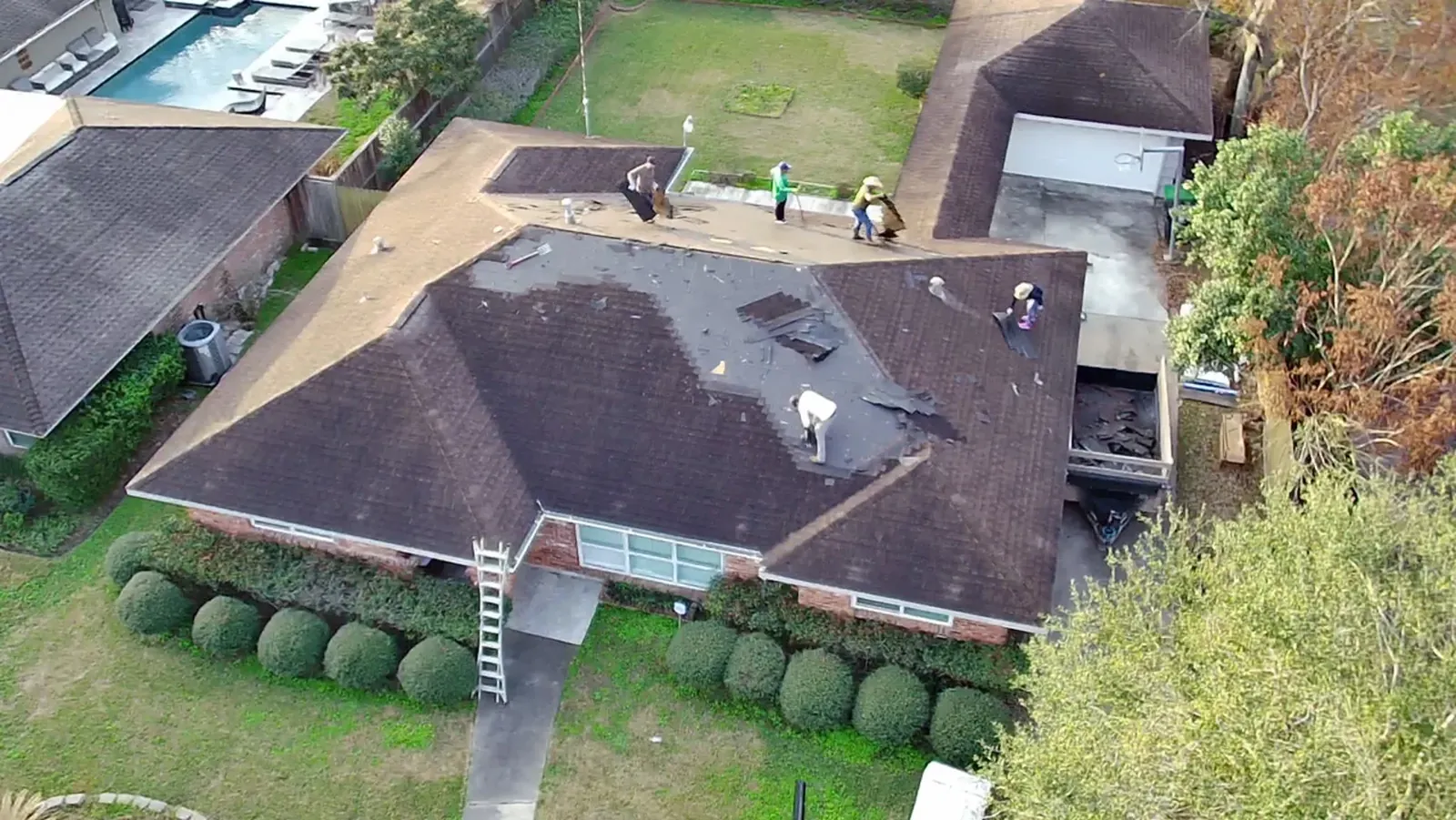
Once the owner and the carrier have settled a claim, or the owner decides to replace without one, the job runs like any tear-off with one difference: everything the stones hit comes off with the shingles. Dented vents and flashing are replaced, cracked decking is swapped out, and gutters that took damage go in the written scope. What goes back on is worth a conversation, because another spring is always coming.
Hail on the roof, and what it actually justifies
Damage from a storm and the need for a new roof are two separate findings, and this is how we tell one from the other.
- Bruised and cracked shingles turn up on most of the roof’s faces, so a repair would mean replacing a large share of the field anyway.
- The soft metal on the roof took dents the size of the stones, and the shingles next to it show strikes that line up with them.
- A ceiling that stayed dry for years started spotting after the spring storm, and the roof above it shows fresh fractures in the mat.
- The roof was near the end of its life before the storm, and the hail damage now spans the whole field rather than a few spots.
- If the stones only scuffed grit off the surface and the mat underneath is still firm, the damage is cosmetic, and we will tell you so plainly.
- Hits limited to the one slope that faced the storm can often be repaired with matching shingles, as long as a match can still be found.
- Marks that turn out to be heat blisters, foot traffic or plain old wear are age, and we will not write them up as hail.
- Dented gutters with clean, firm shingles above them point to a gutter repair, and the roof itself can stay where it is.
From the first photo to the new ridge
- I
Ground look, then a call
Start from your own driveway: dented gutters, a battered downspout and pocked vent caps tell you the stones were big enough to matter. Then call us. One of the owners gets on the roof, checks the metal and the shingles, and tells you whether the storm did real damage or only cosmetic marking.
- II
Every slope on camera
Each face of the roof is photographed close and wide before anything is disturbed, with strikes marked and scaled, and you get the full set. Whether to file a claim, and what your policy pays, stays between you and your carrier, and we leave that call with you.
- III
Adjuster on the roof
If you file, we can meet the adjuster at the house and walk the slopes together, pointing out what we found and where. The adjuster writes the claim. We answer questions about the roof’s condition, and the paperwork decisions stay with you and your carrier.
- IV
Replace in order
Once you decide, the old shingles come off along with every damaged vent and piece of flashing, cracked decking is replaced, and the new roof goes on. Inside the city limits the inspection follows. The before photos and the after photos go to you in one set, so your storm file is complete.
Questions about the storm itself
- What date did the hail come through, and roughly how large were the stones?
- Has an adjuster already been out, or is that still ahead of you?
- Did any dents show up on the car, the mailbox or the AC unit?
- Has any water come into the house since the storm?
- Do you know how old the roof was before this spring?
How quickly should someone look at the roof after hail?
Soon enough that the damage is clearly tied to that storm. Your policy sets its own deadline for a claim, so read it or ask your carrier. An early look also catches cracked shingles before summer rain has weeks to work its way into the decking underneath them.
Should I climb up and look for damage myself?
Please do not. A roof covered in loose grit is slick, and fresh hail marks are easy to misread from a few feet away. The ground tells you plenty: dented gutters, a beaten downspout, pocked vent caps. If you see those, call us and let one of the owners do the climbing.
Will you tell me if the hail damage is only cosmetic?
Yes. Scuffed grit and dented metal with a firm mat underneath is cosmetic on most roofs, and we write it up that way. What you do with that information is up to you, and we will never describe a cosmetic mark as a fracture to help a claim along.
Do you work with my insurance adjuster?
We will meet the adjuster on the roof if you want us there, show each strike we photographed and answer questions about the roof’s condition. We do not negotiate your claim or promise an outcome. What gets approved, and what gets paid, is decided between you and your carrier.
What if only part of the roof was hit?
Then we look at whether a repair can be matched. Hits confined to one slope, on a roof with good years left, often call for replacing those shingles and the damaged vents. A full replacement makes sense when strikes run across most of the roof or the shingles were already worn out.
Should the new roof be different after a hail claim?
It is worth pricing an impact-rated shingle while the old roof is coming off anyway. Whether your carrier adjusts anything for it is a question for your carrier, answered in writing. We put a standard option and a rated option side by side in the scope so you can compare them.
A veteran-owned outfit that photographs before it pulls
Veteran Built is a service-disabled veteran-owned company, a status verified by the Texas Veterans Commission, and both of its owners served. The company itself was founded in 2024. It is a young business run by people with long careers behind them, and after a hailstorm, when strangers start knocking on doors, it pays to know exactly who you are letting onto your roof.
We are based in Cypress and drive down to Arcola for every look, so there is no pop-up storm office in town that packs up when the season ends. The owners who photograph your roof are the same people answering the phone when you call about it next year. If the hail did not hurt the roof, the report says exactly that, and we head home.