
A New Roof for an Arcola House That Has Run Out of Years
When a shingle roof in Arcola has taken several spring hailstorms and a few summers of hard rain, the question is whether the whole thing has worn out or only part of it. We answer that on the roof, with photos, and if the honest answer is not yet, the written scope says so.
Veteran BuiltArcola, Texas
What Arcola’s flat ground does to an aging roof
Arcola is a small city, 2,034 people at the 2020 census, and it has run its own permits and inspections since incorporating in 1986. Inside the limits, a re-roof gets a City of Arcola permit and a city inspector. A lot of houses with Arcola addresses sit past that line, where there is no city permit to pull. We check which side your lot is on before material is ordered.
Gulf Coast storms dump a lot of water in a short time, and on a roof all of it funnels through the valleys and past the flashing at once. On a lot this flat, the ground does not carry it away quickly either, so what the gutters and downspouts do with it matters as much as the shingles. Those are the details an older Arcola roof tends to give out on first, and where we spend the most time on a replacement.
We come down from Cypress, so an Arcola visit gets planned as one trip that covers the roof, the attic, the tape measure and the camera. Nobody should need a second appointment to hear what we found. Our read on repair or replace comes before we back out of the driveway, and the written scope follows.
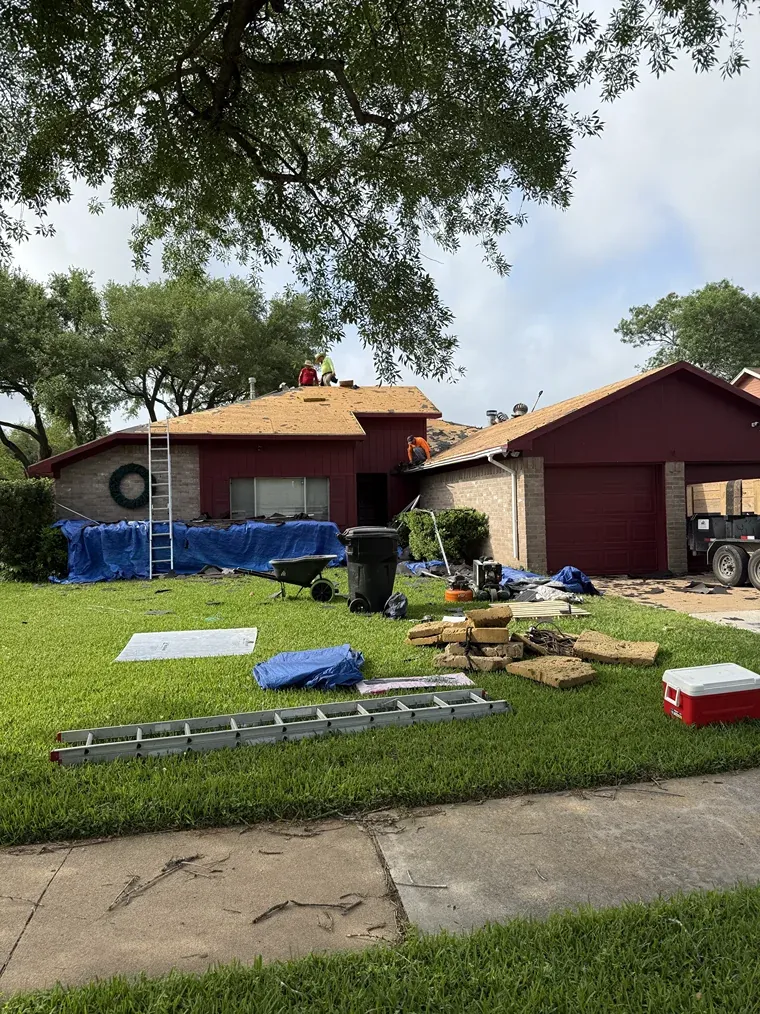
A replacement here begins by stripping every layer down to the plywood, old felt scraps included. Once the sheathing is bare we walk it, and any sheet that flexes underfoot or has gone dark and spongy from an old leak comes out and is replaced with new plywood of the same thickness. We photograph the bad sheets before they leave the roof. Leaving a soft sheet in place means fastening a brand new roof into wood that will not hold a nail.
Over the decking goes synthetic underlayment, with self-adhered membrane laid into each valley and around every pipe, vent and wall the roof meets. A hard downpour sends more water through a valley in ten minutes than most slopes see all day, so we treat the valley membrane as the most important strip on the house. Step flashing along walls is renewed, pipe boots are always new, and kickout flashing at the foot of each wall sends runoff into the gutter and keeps it off the brick.
The edges finish the job. New drip edge goes on at the eaves and rakes so water clears the fascia, and we check that each gutter run actually falls toward its downspout and that the downspouts discharge away from the slab, because on a flat lot that water has nowhere to go on its own. Gutters that are bent or pulling loose get their own line in the scope. Shingles, ridge and vents go on last.
When a whole new roof is the honest answer
Here is how we sort an Arcola roof that needs replacing from one that only looks tired from the street.
- The shingles have shed their granules across whole slopes, so bare asphalt shows on more than one face of the roof, not just one patch.
- The plywood gives when you walk it in more than a few places, and patching shingles over it would mean nailing into wood that has already rotted.
- You have paid for two or three leak repairs in recent years, and a new ceiling stain still showed up after the last hard summer rain.
- Several hail seasons have left the roof so brittle that tabs crack when lifted, so a repair crew would break more shingles than it fixed.
- If the trouble is one valley or one wall where the flashing failed, rebuilding that detail stops the leak, and the rest of the roof stays put.
- A handful of tabs lifted by a summer gust can be sealed back down or replaced singly, which is an afternoon of work and no reason for a new roof.
- A roof with some granule wear and dry, firm decking may have several seasons left, and we will say so and tell you what to keep an eye on.
- A water stain traced to a split pipe boot or a cracked vent collar needs that one part replaced, and the shingles around it can stay.
How one Arcola visit becomes a finished roof
- I
Attic, slopes, camera
The attic comes first, where water stains and pinpricks of daylight show what the shingles are hiding. Then each slope gets walked, the plywood tested underfoot, and the whole roof measured and photographed, so the scope that follows rests on pictures you have already seen with your own eyes.
- II
Scope and permit
The written scope lists the shingle, the color, how extra plywood is handled and what happens to the gutters. If the house is inside Arcola’s limits, the city permit is part of the plan, and nothing gets ordered until we know which office has authority over your address.
- III
Strip and dry in
Tarps go over the beds, the old roof comes off in sections, and soft plywood is cut out and replaced. Underlayment and valley membrane go down the same day, so an afternoon thunderstorm finds the house sealed up tight instead of open to the rafters.
- IV
Shingles, inspection, handover
Shingles, ridge and vents go on, and inside the city limits the City of Arcola inspector sees the finished work. Before the crew leaves, the lawn, beds and driveway get swept for nails. You get the photos of the decking we replaced, and the written scope is checked off line by line against what was done.
Five questions before any price
- How old is the roof, and has it been replaced or only patched since you moved in?
- Where have you seen water inside, and did the stain come back after a repair?
- Is the house inside Arcola’s city limits, or out past the line?
- Have you filed a roof claim before, and is one open right now?
- Is anything fragile planted in the beds along the eaves that we should cover first?
Is my Arcola house inside the city limits?
Your mailing address will not always tell you. Some houses with an Arcola address sit outside the incorporated line, and those need no city permit for a re-roof. We look up the lot before ordering anything, and if the city does have jurisdiction, the permit and inspection are built into the schedule.
Why tear off to the plywood instead of roofing over the old shingles?
Because the plywood is the part we most need to see. A second layer would bury any soft sheets, add weight and hold heat against the new shingles. On a house that has been through several hail seasons, rotten decking is common enough that we want all of it in plain view.
How much plywood usually needs replacing?
Nobody can say until the shingles are off, and anyone who gives you an exact count from the driveway is guessing. The attic offers hints. The scope explains in writing what happens when we find more bad wood than the attic suggested, and every bad sheet is photographed before new underlayment covers it.
Will you replace my gutters with the roof?
Only when they need it. Flat lots make gutters work hard, so we check that each run falls toward its downspout and is fastened tight. Gutters that hold water, sag or were bent by hail go into the written scope as a separate line, and good ones stay right where they are.
What happens if a storm builds while the roof is open?
We only strip as much as the crew can dry in that day, and we read the forecast the evening before a tear-off. If a cell builds faster than expected, open sections get underlayment and tarps before anyone climbs down, and the start date moves when the radar says it should.
Will you tell me my roof does not need replacing?
Yes, and plenty of roofs land there. If the plywood is sound and the wear is limited to one slope or one detail, the scope will say repair, or it will say leave it alone and look again after next spring. That is the reason one of the owners is the one on the roof.
The veteran who climbs your ladder
Leland Cannon served 21 years in the Army and retired as a First Sergeant, the senior enlisted soldier in a company and the one who checks that the job actually got done. He still works that way. On an Arcola roof he wants to press on the plywood himself, look at the valleys with his own eyes, and be the person who explains the findings to you.
One of the two owners walks every job before any number is written down. That means the man telling you a replacement is needed has stood on your roof, and so has the man telling you it can wait another year. Nobody hands your house to a salesperson who has never climbed a ladder there, and nobody pads a scope to make a roof sound worse than it is.