
Laying New Shingles Course by Course on Cinco Ranch Decking
Asphalt shingle installation is the part of roofing that happens on a clean deck: an addition getting its first roof, a garage or porch section, or a house just stripped to plywood. In Cinco Ranch the harder version is a new section that has to meet an older roof without a leak at the seam or a color line you notice from the street.
Veteran BuiltCinco Ranch, Texas
Adding roof to a house on old ranch land
Cinco Ranch ran cattle, rice and peanuts before it ran streets, and the ground is still flat and open. A new roof section here has to move water off the house quickly, because the yard will not carry it away for you. Where an addition meets the existing roof, the valley it creates becomes the busiest drain on the whole house, and we build it that way.
No city government means no city building permit for the shingle work, but an addition that adds square footage is a different conversation. Most of Cinco Ranch is in Fort Bend County with a slice in Harris County, and floodplain status depends on your lot. We look up what applies to your address before a new roof section goes on the calendar.
Your association’s architectural review will likely want to see the shingle for a new section too, and matching matters more here than on a full re-roof. A porch roof in a slightly different blend reads as a patch for years. We bring the old product name if we can find it and samples if we cannot, and nothing is ordered until the review signs off.
Every installation starts at the perimeter. At the eaves, the metal drip edge goes down before the underlayment; at the rakes it goes on after, lapping over, so wind-blown rain finds no gap to slide into. Synthetic underlayment covers the plywood between them. A starter course with a factory sealant line runs the eaves and rakes, which gives the first full course something to bond to on its first hot afternoon.
Valleys get self-adhered membrane under the shingles, and on a tie-in that membrane runs well up under the existing roof, which means lifting the old shingles along the seam. Courses follow the exposure on the bundle label, with nails in the band the manufacturer marks, so every shingle is held where it was designed to be held. Joints are staggered so water never finds a straight path down the slope.
Three-tab or laminated is a real choice on a new section. If the existing roof is three-tab and sound, matching it keeps the addition from standing out. And if the old roof is close to the end of its life, the honest conversation may be about doing the whole house now, so every slope ages together and nobody has to open the seam again later.
New shingles on a new section, or the whole roof?
A small installation sometimes points at a bigger job, so here is how we decide what a Cinco Ranch house actually needs.
- You are adding a room, a garage bay or a covered porch, and the existing roof is sound enough to tie into for a long while yet.
- The house was just stripped to the plywood after storm damage, and the deck is ready for underlayment and a full new field of shingles.
- A detached garage or shed roof has worn out on its own schedule, while the main house roof still has plenty of life left in it.
- A porch or patio cover has enough pitch to shed water off shingles, and your association’s architectural review has signed off on the plan.
- If the existing roof is near the end of its life, tying a new section into it means opening that same seam again when the old roof goes.
- A patio cover that barely slopes needs a low-slope membrane instead, because shingles laid on it hold water and leak at the laps.
- If the old shingle color is long discontinued and no blend comes close, a new section may stand out, and we show you that before you commit.
- Framing that is not square or flat yet is not ready for shingles, and we will tell you so before anything goes on top of it.
Deck check, edges, field and the tie-in
- I
Deck and framing check
Before a bundle comes off the truck, we walk the new plywood for gaps, soft spots and nails that missed the rafters, and look at the existing roof where the new section will meet it. A deck that is not ready gets fixed before anything covers it.
- II
Drip edge and membrane
Drip edge goes on, synthetic underlayment covers the deck, and membrane lines every valley and wraps every pipe. On a tie-in, we lift the old shingles along the seam so the new membrane slides up underneath them and water has no edge to catch on.
- III
Courses and caps
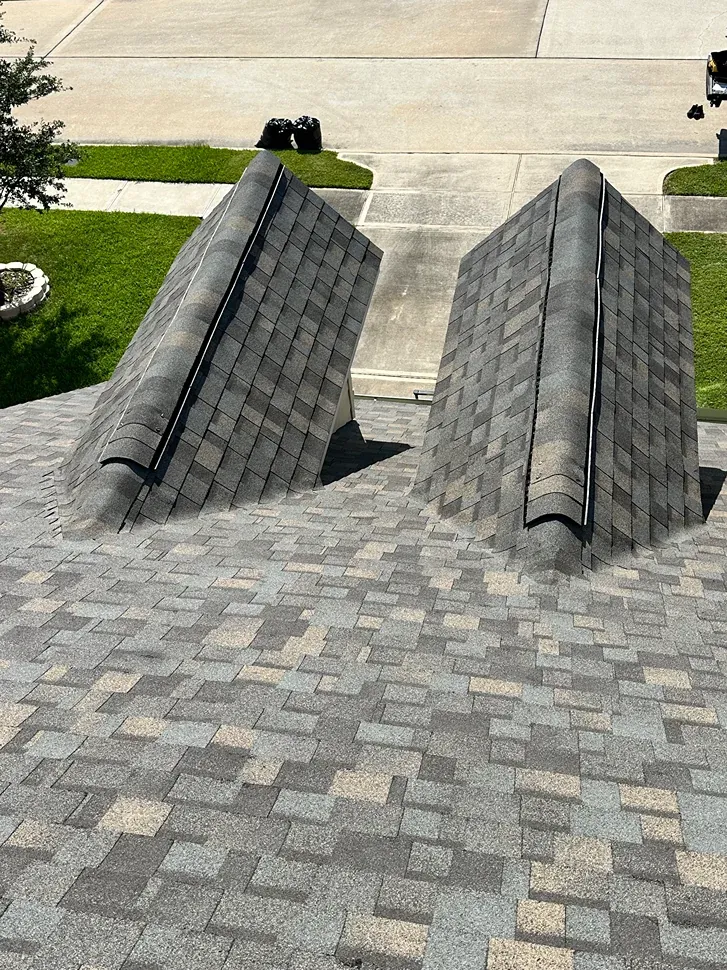
Starter first, then full courses at the printed exposure, nails in the marked band, joints staggered. Hips and ridges get caps from the same product line, and where a new ridge meets an old one, the caps overlap in the direction the water runs.
- IV
Following the water
We stand at the gutter line and trace the path from the new valley to the downspout, then check that each downspout discharges away from the slab. After that you look at the new section from the street with one of us, and nails are swept off the drive.
Before the first bundle goes up
- What is the new roof covering: an addition, a garage, a porch or the whole house?
- Do you know the brand or color name of the shingles already on the house?
- Has your association’s architectural review seen the plans for the addition?
- Where does water collect in the yard after a heavy summer rain?
- Will anything be mounted on the new section later, like lights or a satellite dish?
Will a new roof section match my existing shingles?
As close as we can get it, and we will be straight about how close that is. Even the same product name weathers differently after years in the sun. We hold samples against the old roof in daylight, and if the match is going to show, you see that before anything is ordered.
Where do leaks start on an addition roof?
Most often at the seam, where the new roof meets the old one or meets a wall. That is why the membrane runs up under the existing shingles, step flashing goes in course by course along any wall, and the valley at the tie-in gets more care than anything else on the job.
Should I choose three-tab or laminated shingles?
On most new work we lean laminated, because it is heavier, hides small waves in the decking and holds better in wind. Three-tab can make sense when a sound three-tab roof needs a small matching section next to it. We lay out both options side by side in the written scope.
How do you flash a new roof section against brick or siding?
Against siding, step flashing tucks behind the siding course by course. Against brick, the step flashing gets a counter flashing set into a mortar joint, so the brick covers the step pieces. A kickout at the bottom of the wall turns runoff into the gutter instead of down the face of the house.
Can you put shingles on a flat patio cover?
Not if it is truly flat or close to it. Shingles shed water by overlapping and need enough pitch to do that, and on a low slope the water backs up under the laps. We look at the framing and tell you whether it can take shingles or needs a different roof.
What do you do about gutters on a new section?
We check whether the new roof sends water to an existing gutter that can handle it, or whether it needs its own run and downspout. On a flat lot, a downspout that empties next to the slab is a problem, so the discharge point gets planned along with the roof itself.
Two owners who measure before they shingle
Veteran Built is Leland Cannon and Geoff Schardien, two veterans who started the company in Cypress in 2024. Leland served from 1997 to April 2018 and retired an Army First Sergeant. Geoff served in USAF Security Forces and has worked in residential construction for more than 20 years. One of them walks every Cinco Ranch job before a scope gets written.
On a tie-in, that walk matters more than usual, because the existing roof has to be read before the new one is drawn into it. If the old roof will not last long enough to justify the seam, you will hear that, along with the choice between doing the whole house now or waiting. Call (832) 364-6271 and Leland picks up.